Proprietary tools and modules
500+
Proprietary technology with context-aware selection and controlled execution — not isolated scanner runs. Covers web, API, mobile, cloud, Kubernetes, Active Directory and source code.

Penetration testing and offensive security
Offensive security assessments for web apps, APIs and critical systems, with the same methodology as the elite researchers in international bug bounty programs.
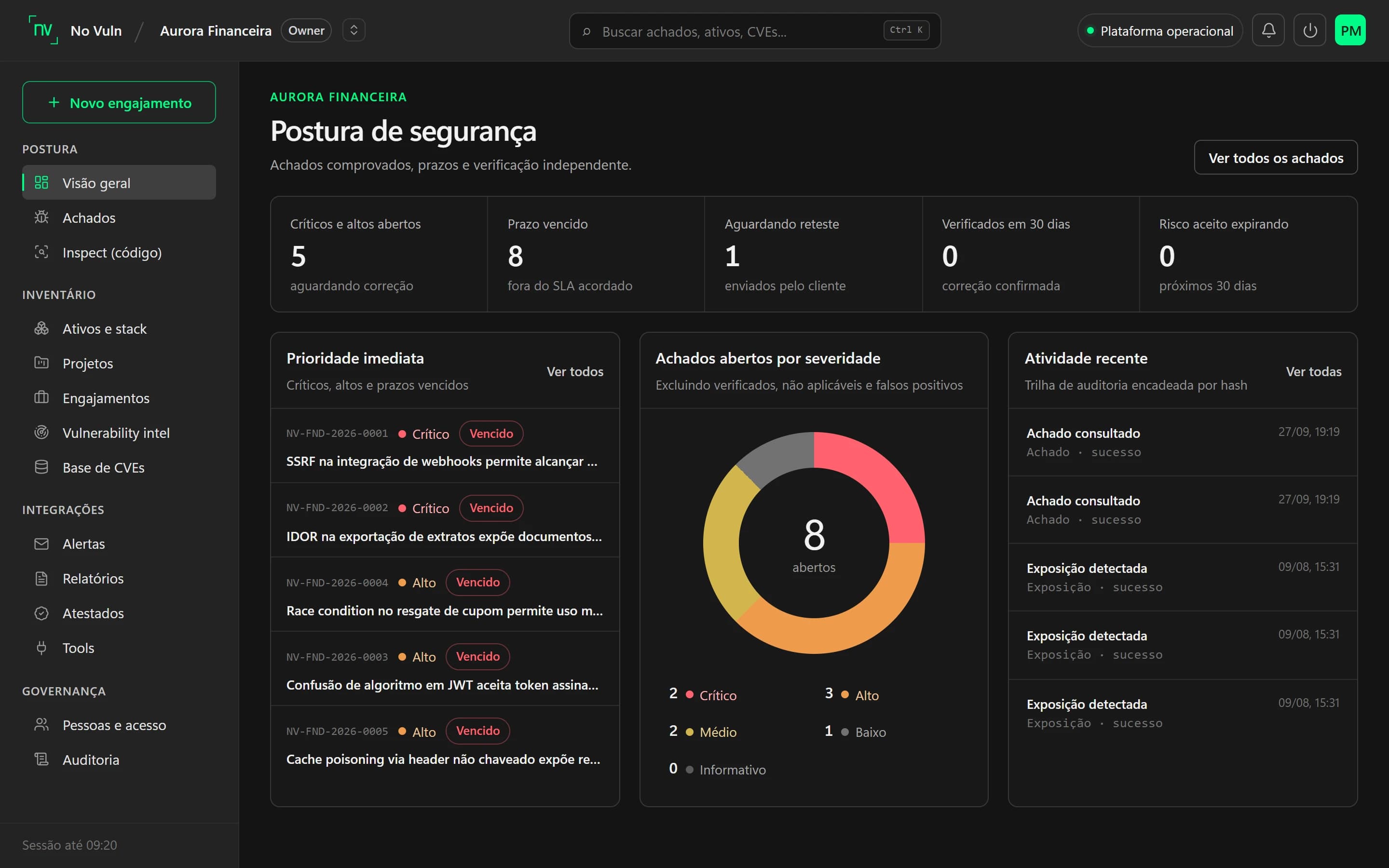
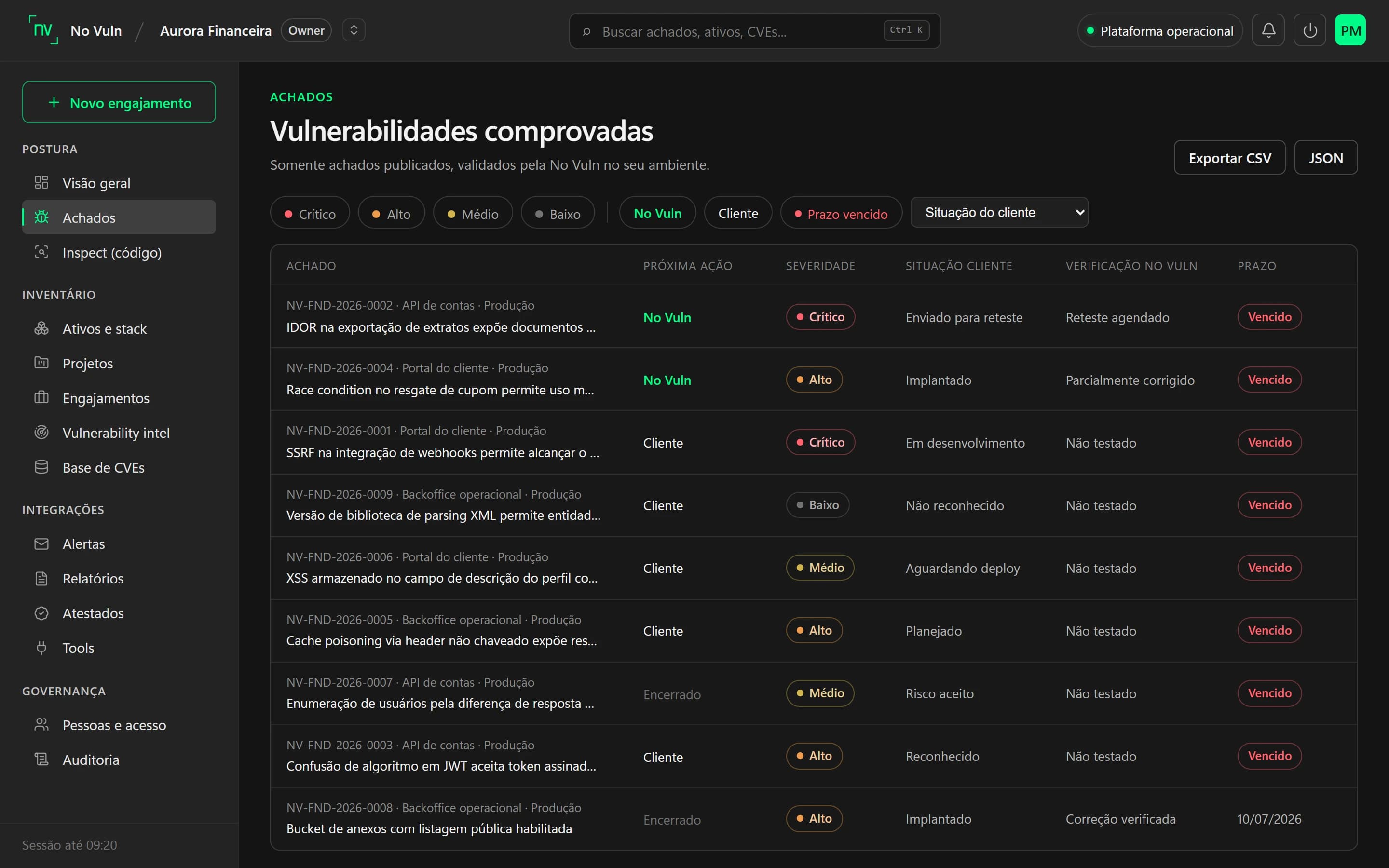
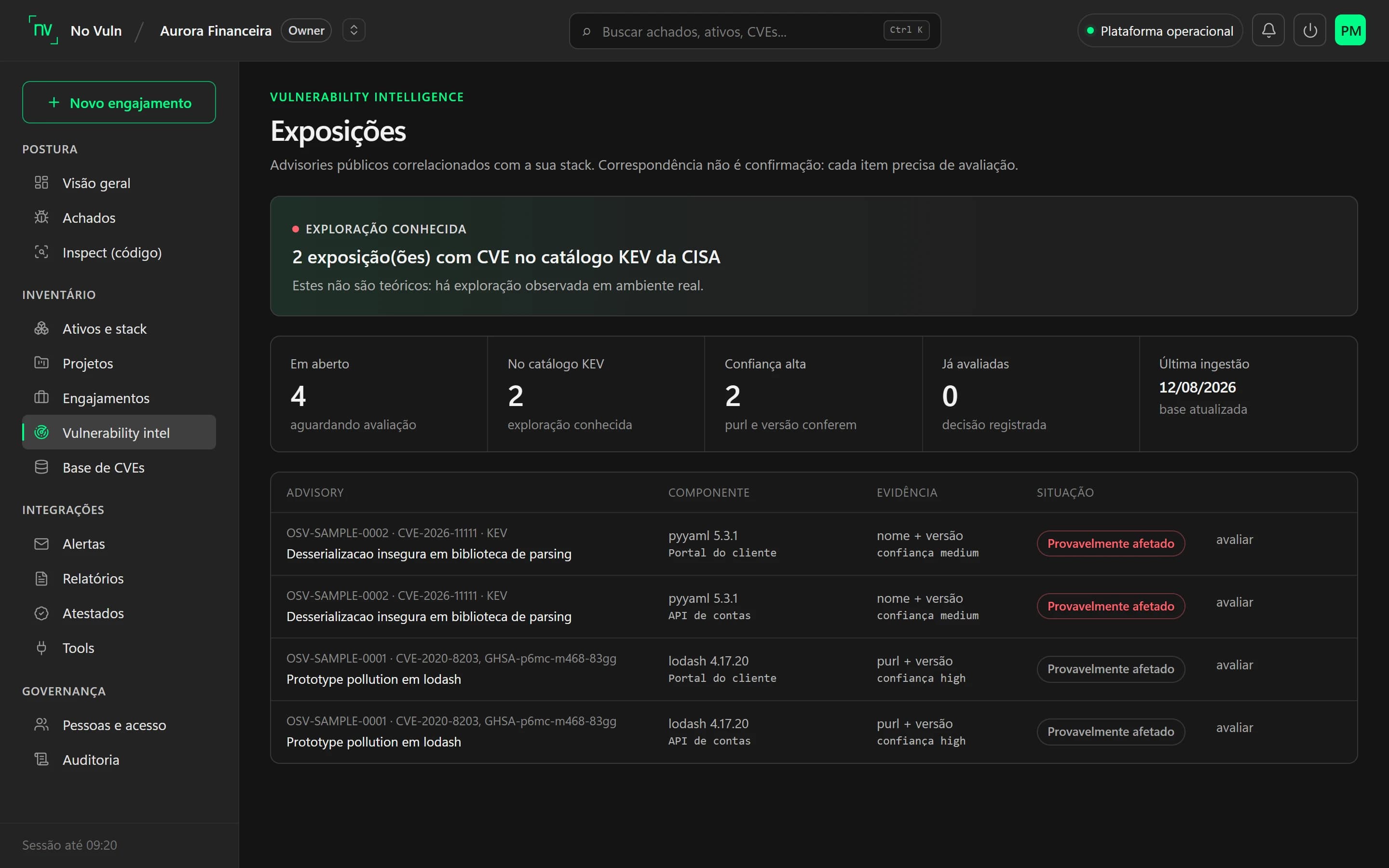
No Vuln Hub — client portal. Demo data.
Platforms where No Vuln has found vulnerabilities










Services
We think like real attackers so you never have to react like a victim.
Penetration testing
Controlled, in-depth attack simulation: web application, APIs, authentication, sessions, integrations and business logic. You choose the testing mode — black box, grey box or white box — one or combined, depending on your goal.
For launches, due diligence, compliance and enterprise customer security reviews.
Source code security audit
Source code review that doesn't depend on a running environment: authorization, parsers, state machines, secrets, dependencies and supply chain. Every finding points to the file, the line and the recommended fix.
For major platform changes, stack migrations, M&A, SOC 2/ISO 27001 readiness — or before the code reaches production.
Continuous pentesting and monitoring
Recurring pentests aligned with your sprints and continuous monitoring of your attack surface: new endpoints, dependencies with CVEs prioritized by KEV and EPSS, public leaks (GitHub, pastebin, dark web). All tracked in No Vuln Hub.
For growing SaaS companies, fintechs and high-volume e-commerce.
Coverage
Monolith or microservices, REST or GraphQL, mobile-first or legacy B2B — it doesn't matter.
Frontend and backend.
OWASP API Top 10.
Where 40% of P1 bugs live.
Trusting a partner means inheriting its risk.
App + traffic + storage.
AWS, GCP, Azure.
Applied according to each engagement's goal, with traceable evidence when your customer or auditor requires ISO/IEC 27001, SOC 2 or PCI DSS.
No Vuln Methodology
Most assessments run Nessus, export a PDF and charge a premium. We built something different.
The No Vuln Methodology is our proprietary approach to adversary emulation: senior offensive security researchers leading proprietary technology integrated with frontier AI models. Instead of running a scanner and producing a PDF nobody reads, we attack your system the same way elite researchers attack companies in international bug bounty programs — hunting for the developer's wrong assumptions, not just unsanitized inputs.
The technology extends reach, depth and consistency. The researcher defines the scope, authorizes every sensitive action and signs off on every finding.
Talk to a researcher
Proprietary tools and modules
Proprietary technology with context-aware selection and controlled execution — not isolated scanner runs. Covers web, API, mobile, cloud, Kubernetes, Active Directory and source code.
Attack sub-vectors mapped
1,017 sub-vectors across 86 vectors — from OAuth, SAML and GraphQL to cache poisoning, race conditions and request smuggling. The OWASP Top 10 lists 10 categories.
CVEs with KEV and EPSS
Vulnerability intelligence maintained by No Vuln to prioritize what actually affects your stack — exploited in the wild (CISA KEV) and likely to be exploited (EPSS).
up to 7.4×
more reach per pentest hour than a traditional consultancy. Same budget, more coverage — and a more secure system.
How it works
From the first call to final delivery, every step is led by researchers — documented, reproducible and auditable.
Technical call with your team, NDA and authorization letter signed, access set up for the testing mode (black, grey or white box) and testing windows agreed.
Passive reconnaissance and mapping of the exposed surface — domains, APIs, integrations, JS bundles and public repositories — plus traffic capture (HAR) and a walkthrough of authentication and business flows with your team.
Study of the technologies, business rules and integrations to develop the most likely vulnerability hypotheses, prioritized by impact on your business.
Researchers execute the plan with No Vuln's proprietary tooling. Every finding is proven with a reproducible PoC, with no impact on production.
Every finding goes through 6 validation gates before delivery. Executive and technical reports, a readout session with your team and a retest included after the fix.
Clients
Some of the companies that have put their systems to the test with No Vuln.






Blog
Technical articles on vulnerabilities, OAuth, compliance and the pentest market. No buzzwords.

GuideJun 10 202613 min
Grey box pentesting in 2026: credentialed methodology, real coverage, when it fits SaaS and fintech, cost, and how it compares with black and white box.
Read article
VulnerabilityJun 09 202612 min
A recent pentest of an established B2B SaaS: 7 small flaws chained into a full pre-auth admin takeover from zero — no user, no password.
GuideJun 07 202612 min
Black box pentesting in 2026: definition, methodology, real coverage, when SaaS and fintechs should use it, cost, and how it pairs with grey and white box.
FAQ
Pricing, timelines, compliance, confidentiality and how the work happens — in plain language.
See all 115 questionsThe only reliable way is a penetration test performed by human experts, not just automated scanners. Scanners find the obvious bugs — outdated versions and trivial XSS — but business logic flaws, exploit chains and wrong assumptions only show up with manual analysis. Regular assessments plus continuous attack surface monitoring give you the real picture of your risk.
SOC 2, ISO 27001 and PCI DSS explicitly require penetration testing. Privacy laws such as GDPR and Brazil's LGPD require appropriate technical security measures — and a documented pentest is one of the few concrete ways to prove them to a regulator or an enterprise customer's security review.
It depends on the scope. Pentests are contracted in hour packages: No Vuln Sprint (25h, US$ 3,750 to US$ 6,250) for smaller applications, MVPs and early-stage SaaS; No Vuln Deep Dive (50h, US$ 7,500 to US$ 12,500) for production systems with an active customer base; and No Vuln Full Scope (100h+, from US$ 15,000) for enterprise pentests with full white box, mobile and cloud. Rates range from US$ 150 to US$ 250 per hour depending on stack, testing mode and timeline. PTaaS (continuous) is quoted on request. Every engagement gets a tailored proposal once the scope is defined.
A pentest is an attack simulation with a clear goal: break in. You find out exactly what a real attacker could do to your system today. An audit is a structured review, with access to the code and infrastructure, assessing design, missing controls and security debt. A pentest shows what breaks now; an audit shows what will break later. They complement each other.
No. We work with controlled exploitation, always within the agreed scope. Destructive tests only happen in staging or in an agreed maintenance window. In production, we validate every bug with a minimal PoC — no payloads that cause downtime.
No. All the work is done with your application running normally. In rare cases (specific DoS tests, high-volume race conditions), we agree on an off-peak window or a mirror environment.
Yes. A pentest contracted in writing, with a defined scope and an NDA, is a regulated practice required by standards such as ISO 27001, SOC 2 and PCI DSS.
From 1 to 8 weeks, depending on the package and the complexity of the scope. The Sprint (25h) fits within a window of up to 21 business days; Full Scope (100h+) can take up to 8 weeks for full-stack coverage.
Yes, at specific stages — such as mapping the attack surface and organizing large codebases — our proprietary technology works alongside frontier AI models. Every hypothesis is validated by a researcher before it becomes a finding. AI accelerates. People decide.
Scanners find the obvious bugs — outdated versions, misconfigurations, trivial XSS. Our work starts where the scanner stops: business logic, exploit chains, wrong assumptions. Those bugs don't show up in any scanner.
You receive a report attesting the tested scope, the methodology applied and the vulnerability classes verified — a valid compliance deliverable. In practice, almost no production web application comes out of one of our assessments without at least one critical or high finding.
You fix the issue, open a ticket with us, and we validate the fix within the period defined in the proposal (60 days for the Sprint). With PTaaS, retesting is part of the continuous cycle. No extra charge.
Yes. We work remotely with companies outside Brazil. Proposals, contracts and NDAs are issued in the client's language, reports are delivered in the language of whoever requests them, and you talk directly to the researcher. We're based in Brazil (UTC−3), with good overlap with US and European business hours.
International clients are invoiced in USD, via Wise or international wire transfer: 50% at kickoff and 50% on delivery. PTaaS is billed on a recurring basis.
Always. We send our standard NDA before the first technical call — and we're happy to sign yours if you prefer.
Get in touch
Tell us what you need tested. Our team replies within 1 business day (Brasília time, UTC−3) with an initial scope assessment.

Direct line
Talk to our team on WhatsApp right now. Replies within minutes during business hours (UTC−3) — no forms, no waiting.